
Building Your Portfolio: Strategy, Risk, and the Big Picture
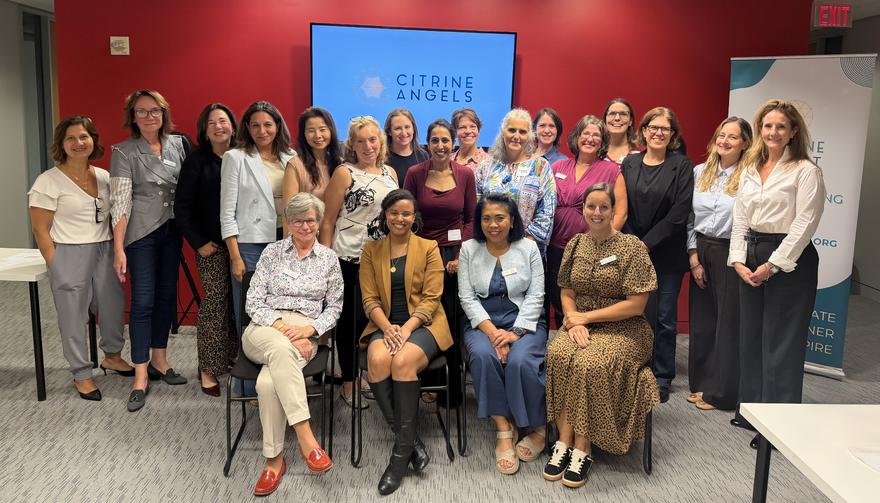
Citrine's 2026 Female Funder Series wrapped up on October 1 at Refraction in Tysons Corner with a conversation about what happens after you learn to evaluate a deal: how individual checks add up to a strategy.
Citrine Executive Director Dawn Myers moderated a panel of three investors with very different vantage points:
- Dahna Goldstein, Managing Partner of Halcyon Venture Partners, which invests at seed in climate, health, and equitytech. Dahna also brings the founder perspective as a two-time founder, including PhilanTech (acquired by Altum in 2014).
- Tahira Dosani, Co-Founder and Managing Partner of ResilienceVC, a DC-based seed fund focused on fintech that builds financial resilience. Before investing, Tahira was a fintech operator.
- Mary McLaughlin, a Citrine member of four years, angel investor, and corporate board director, who brought the perspective of an individual angel refining her strategy in real time.
Here are a few of the ideas that stood out.
It's a numbers game, so get more shots on goal
All three panelists agreed that most early-stage companies will fail, and only a few will become the outsized winners that drive portfolio returns. There's no magic number, but more checks improve your odds.
For most people, that means writing smaller checks. Tahira noted that investing through networks like Citrine opens the door to lower minimums, which lets you back more companies. Diversification also means spreading across sectors, stages, and business models. If every company in your portfolio is a lending business and interest rates rise, they all face the same risk at once.
Investing as an LP in a venture fund is another way to diversify. One check gives you exposure to the 20, 30, or 40 companies a fund backs. Most funds also call capital over time rather than all up front, which makes a commitment easier to manage.
Dahna added one key distinction: as an angel, you make each investment decision yourself, while as an LP, you're betting on the fund manager and handing them the portfolio decisions.
Know why you invest, and write it down
Dahna challenged the room to think about what's really motivating each bet. Angels should invest in companies they think will generate returns, but financial return is rarely the only reason we invest. Angel investing also lets you back founders who speak to you, keep learning, and bring your own experience to bear.
That's where a personal investment thesis comes in. Dahna described a recent workshop with Halcyon's angel network that walked through the tensions every angel weighs: market versus founder, financial returns versus other goals, and industries you know versus ones you want to learn.
Mary shared her own criteria, which have sharpened over four years and about a dozen investments:
- A company that solves a real problem
- A big addressable market with room to grow
- A scalable model
- A founder she believes in
She also watches her mix. With a lot of consumer products in her portfolio already, she's looking elsewhere for now.
Mary also budgets annually for angel investing and recommends agreeing on that number with a spouse or partner up front, so each new opportunity doesn't become its own conversation.
You're betting on the founder
Tahira pointed out that it has never been easier to build a product, which also means a competitor can copy it quickly. Products will change. What matters is whether the founder can adapt, take feedback, and lead through uncertainty.
Dahna said she digs deeply into seed-stage financials while knowing the projections will be wrong. What she's really looking for is how the founder thinks about the business and its key levers. One of her favorite diligence questions is: How will your customers' processes have to change to adopt this? The strongest founders have already asked their customers that question.
Mary looks for a founder who can make hard decisions when funding gets tight, and who knows her limitations and surrounds herself with good people and advisors.
After the check: expect a second ask
Dahna described PhilanTech as "10 years to an overnight success." Things almost always take longer than founders expect, and most companies that raise equity will need to raise again. If you write a first check, expect to be asked for a second one. The healthiest companies treat each round as a milestone that reduces some piece of risk in the business.
But follow-ons aren't required. Tahira said it's perfectly fair for an angel to write initial checks only, and some funds work that way too. A follow-on comes in at a higher price, so the company has to grow even more for that check to match your original return.
The panel also explained pay-to-play terms, which penalize existing investors who don't participate in a new round, often through heavier dilution. One pay-to-play round can reflect a hard moment, but repeated rounds may be a red flag. Dahna distinguished those from insider rounds raised to reach a specific, credible milestone, such as an FDA approval or a pilot that's taking longer than planned.
Valuation: more art than science
Asked how to tell whether an early-stage valuation is reasonable, Tahira suggested two steps. First, check the unit economics: can the company make and sell one unit for more than it costs to produce and serve that customer? Then picture the business at a realistic exit, apply comparable multiples from later-stage companies, and work backward.
Dahna recommended Carta's published data on valuations by sector, stage, and geography as a sanity check. She noted that East Coast valuations tend to be more conservative than West Coast ones, and that AI valuations are skewing the numbers right now. Tahira added that many angel rounds use SAFEs or convertible notes, which push the valuation question to a later round. And because early-stage outcomes are so binary, if you believe a company could become very large, the exact entry price matters less than being in the deal.
One closing thought
The panel closed with the panelists sharing advice for anyone building a first portfolio, and the response was unanimous: invest in people who are building the world you want to live in.
We thank everyone who joined us for the 2026 Female Funder Series. Across three sessions, we went from demystifying angel investing to evaluating founders and deals and building a portfolio, and we're grateful to have learned alongside so many current and future angels.
Support Citrine Impact
The Female Funder Series is made possible by Citrine Impact, our 501(c)(3) that educates women on how to angel invest. If the series helped you, whether by giving you the confidence to write your first check or by sharpening how you think about the next one, we hope you'll consider a gift to our Year-End Citrine Impact Donation Drive. Your support helps us bring this education to more women in 2027 and beyond. You can donate at CitrineImpact.org.